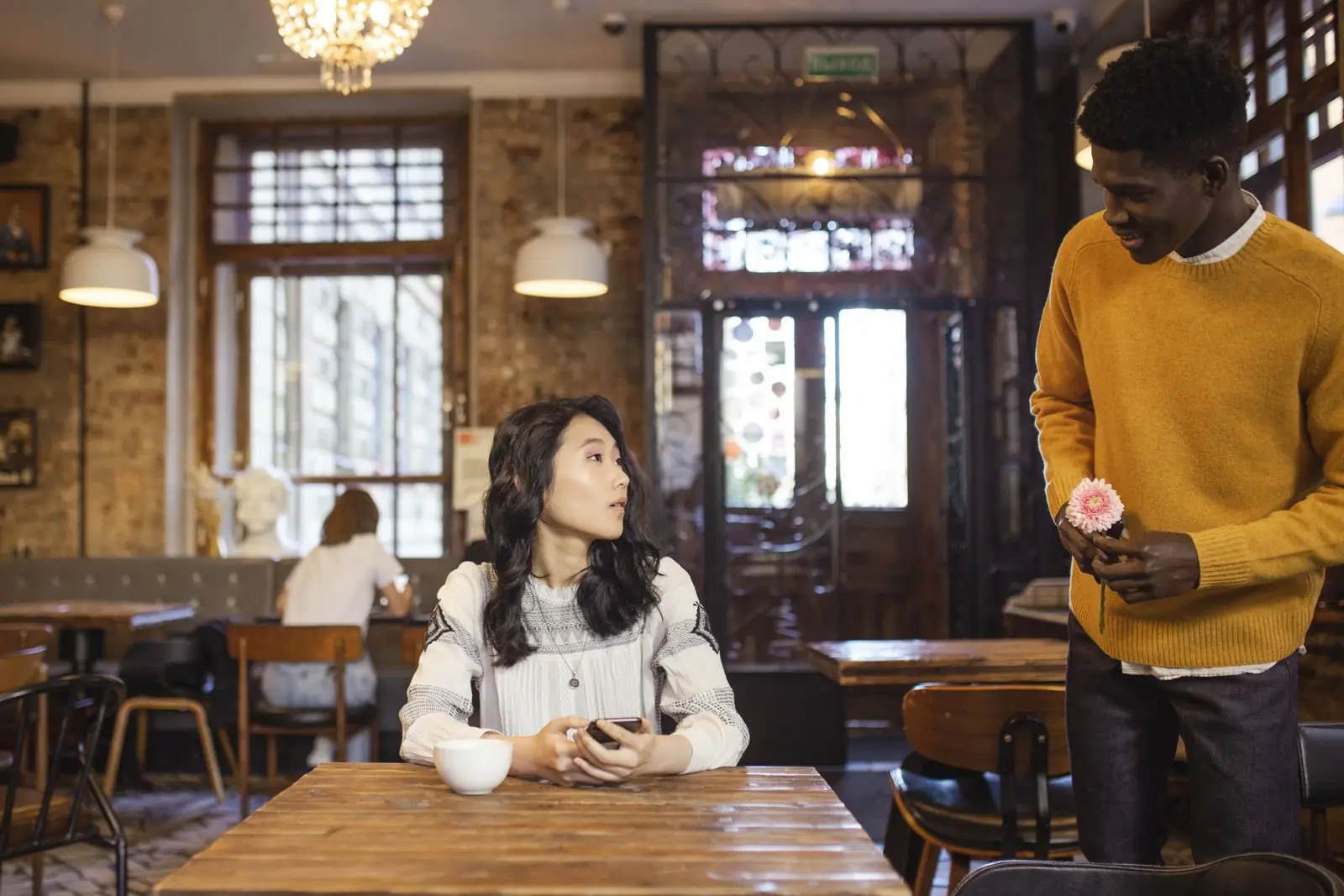
Most first dates are uneventful in the best way. Safety habits aren't about expecting the worst — they're about making it easy to leave, easy to get help, and hard for the rare bad actor to take advantage, so you can relax and enjoy the evening.
Before the date
- Check they're real. Does their name and photo match a social profile? A reverse image search catches stolen photos. A short video call or voice note helps; someone who always avoids it is a warning sign.
- Choose a public, busy place with staff — not their home, not yours, not a remote walk.
- Get there and back on your own. Don't accept a lift on a first date, and don't share your address yet.
- Tell a friend who, where and when, and agree a check-in time: "If I haven't texted by 10, call me."
Share your location
Use Find My (iPhone) or Google Maps location sharing for the evening. Some countries have official tools too — the Czech Záchranka app's Patron feature shares your live location with a trusted person for a set time, and Germany's Heimwegtelefon volunteers will stay on the phone while you walk home at night.
During the date
- Watch your drink; if you leave it, order a new one.
- One or two drinks is plenty.
- Keep your phone charged and on you.
- Trust the feeling. Pressure to drink more, move somewhere private, or comments that make you uneasy — leave. "I'm going to head off, take care" is a complete sentence.
- Use the venue. Ask staff for help or a taxi. In the UK (and many Dutch venues) ask for "Angela"; in Germany and Austria ask for "Luisa".
Red flags
Pushing to change plans to somewhere private · anger when you set a boundary · pressure to drink · insisting on paying, then implying you "owe" them · their identity not matching what they told you.
Romance scams
The most common harm from online dating is financial:
| Country | What's reported |
|---|---|
| UK | £102M lost in 2025 across 10,784 reports (+29%); average £9,500 |
| US | $1.14B lost in 2023 (FTC); most romance-scam losses now start on social media |
| Germany | At least €50M a year; Berlin alone 433 reports and €5.6M in 2024 |
| Czech Republic | Average loss over 500,000 CZK per victim (Police) |
The pattern: attractive, fast-moving profile → a reason they can't meet or video call → a sudden crisis → a request for money, gift cards or crypto. Never send money to someone you haven't met in person.
Emergency numbers
| Country | Emergency | Police | Also useful |
|---|---|---|---|
| UK | 999 / 112 | 101 (non-emergency) | Ask for Angela |
| US | 911 | — | 988 crisis line; Safe Horizon 1-800-621-4673 (NYC) |
| Germany | 112 | 110 | Heimwegtelefon 030 12 07 41 82; Luisa ist hier |
| Austria | 112 / 144 | 133 | Vienna women's emergency line 01 71 71 9 |
| Netherlands | 112 | 0900-8844 (non-emergency) | Ask for Angela |
| Czech Republic | 112 | 158 (also SMS) | Záchranka app (Patron) |
After the date
Text your friend that you're home. If there's no spark, a short kind message is enough. If someone behaved badly, report them on the app — it protects the next person.